

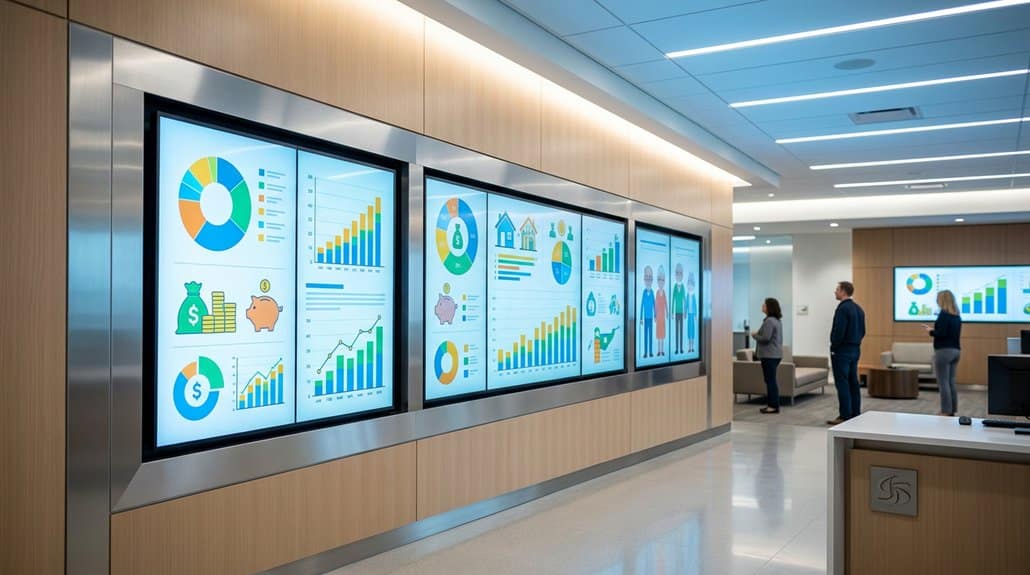
You’ll see how banks and financial services are transforming education through digital signage, enhancing financial literacy with vibrant, interactive displays. These tools simplify complex concepts like budgeting and investing, boosting engagement by 30%. Branches use real-time content personalization, making customer interactions more informative. Plus, with advanced technology like cloud updates and data analytics, content stays relevant and targeted. Discover how these strategies lead to higher customer satisfaction and loyalty in banking.
Key Takeaways
- Banks utilize digital signage to provide real-time financial literacy education through interactive and engaging content.
- Financial institutions display educational content on budgeting, saving, and investments using visually appealing digital formats.
- Interactive displays boost customer engagement and simplify complex financial concepts, aiding in information retention.
- Digital signage in branches displays personalized financial learning experiences and real-time updates on banking products.
- Banks leverage real-time updates and mobile integration for cohesive and continuous financial education.
What Is Digital Signage in Banking?
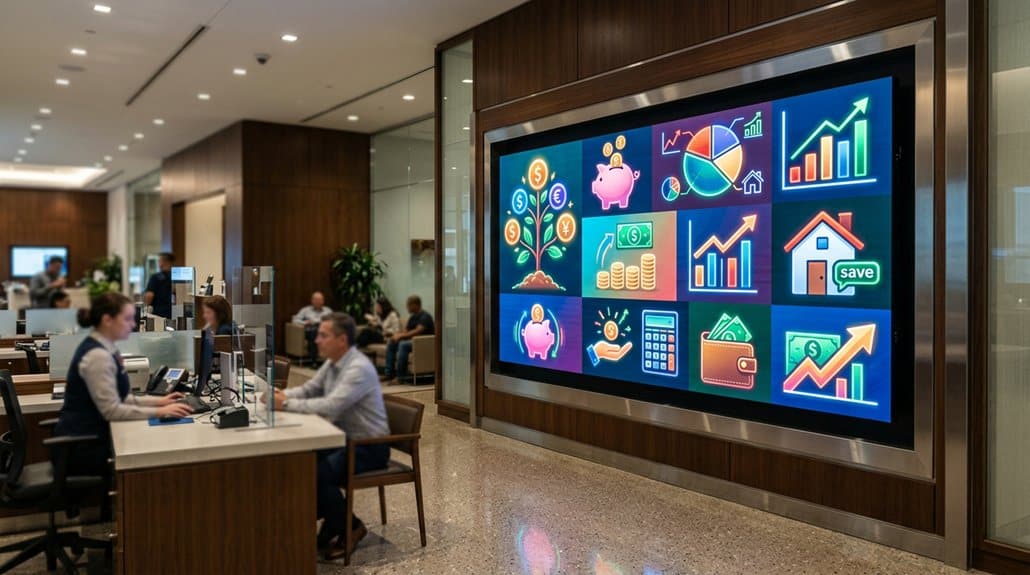
Digital signage in banking represents a dynamic tool for real-time communication within financial settings like branches and ATMs. As a customer interface, it revolutionizes how banks engage with you by presenting important information through visually engaging content. This visual communication can include infographics and promotional videos, ensuring you’re informed about changes such as interest rates, service updates, and special offers.
Enhancing Financial Literacy With Digital Displays
When banks utilize digital displays, they’re not merely decorating their branches; they’re transforming the way financial literacy is conveyed to clients. By harnessing financial technology, these displays deliver real-time, educational content on budgeting, saving, and investment strategies. Research highlights that interactive digital signage boosts customer engagement, as users appreciate timely updates on interest rates and loan options. This dynamic visual communication simplifies complex financial concepts, making them easily digestible for diverse audiences, like young adults and first-time banking customers.
Incorporating visually appealing graphics and concise messaging, these displays support financial literacy campaigns, substantially increasing customer satisfaction. Empowered clients feel more knowledgeable about their financial choices, ultimately fostering trust and driving service utilization within their preferred financial institutions.
Why Digital Signage Boosts Bank Engagement

You’ll find that digital signage plays an essential role in boosting bank engagement—especially by enhancing interactive financial learning. Interactive displays allow customers to explore financial products at their convenience, leading to a 30% increase in information retention and customer satisfaction. Additionally, these visually engaging tools increase in-branch interactions by capturing attention, resulting in a noticeable uptick in foot traffic.
Enhancing Interactive Financial Learning
Leveraging digital signage in banks substantially boosts customer engagement by transforming how financial information is conveyed. Digital signage enhances interactive financial learning through:
- Interactive Tools: Utilize video tutorials and infographics to make complex financial products easier to understand.
- Customer Feedback: Adapt content to better serve customers by analyzing interactions and preferences, guaranteeing relevant information is displayed.
- Information Retention: With interactive displays, you achieve up to a 65% retention rate, compared to traditional static methods.
- Personalized Learning: By incorporating QR codes, customers access additional resources tailored to their needs, directly from their smartphones.
These strategies not only improve financial literacy but also guarantee that real-time, tailored content reaches the right demographics, aligning with current market trends for maximum impact.
Increasing In-Branch Engagement
Digital signage can considerably boost in-branch engagement by transforming the customer experience with real-time financial education content. By displaying dynamic, personalized messages, you can increase customer interaction by up to 30%, crafting effective engagement strategies to keep clients informed and involved. Studies show that showcasing current products and services through digital displays enhances awareness and cross-selling prospects by providing contextual information. This targeted approach aligns with customer demographics and preferences, maximizing satisfaction.
| Benefit | Percentage Increase |
|---|---|
| Customer Interaction Boost | 30% |
| Cross-Selling Opportunities | Contextual Insight |
| Customer Satisfaction | Personalized Content |
| Financial Decisions | Education-driven |
Incorporate financial literacy tutorials to help clients make informed decisions, further anchoring customer loyalty and bank engagement with essential updates and promotions showcased efficiently.
Showcasing Financial Content on Digital Platforms
- Educational Content: Banks display budgeting tips, savings strategies, and investment advice to empower informed decision-making.
- Real-Time Data: Customers gain access to up-to-date interest rates, loan options, and financial products, enhancing awareness.
- Personalized Learning: Interactive signage allows customers to choose topics, boosting retention and tailoring education to individual needs.
- Increased Engagement: With digital signage, customer inquiries and engagement can rise over 30%, leading to higher conversion rates.
Enhancing Service With Digital Signage

Building on the value-adding potential of showcasing financial content on digital platforms, enhancing service with digital signage in the banking sector takes client engagement a step further. This approach allows banks to refine their content strategy, ensuring a seamless customer experience. You can benefit from real-time updates on interest rates or financial market trends, influencing your financial decisions with timely data.
| Benefit | Impact |
|---|---|
| Real-time Updates | Informed financial decisions |
| Financial Education Materials | Empowered financial behavior |
| Promotions & Announcements | Increased engagement and product uptake |
Tech Tools Making Bank Signage Smarter
As technology continuously evolves, banks are leveraging advanced tools to make digital signage smarter, thereby enhancing customer interaction and information delivery. By integrating tech tools such as interactive kiosks and data analytics, banks create personalized experiences that boost customer engagement. Here’s how they’re doing it:
Banks boost customer engagement by using interactive kiosks and data analytics for personalized digital signage experiences.
- Interactive Kiosks: These allow customers to explore financial products and educational content at their own pace, leading to improved information retention.
- Data Analytics: By analyzing customer demographics and behavior, banks tailor educational content, ensuring messages resonate with specific audiences.
- Cloud Solutions: Banks can update content remotely across locations, keeping educational displays current and relevant.
- Gamification Strategies: Turning financial education into fun exercises encourages customers to learn about budgeting and investment actively.
These tools collectively drive enhanced engagement in banking environments.
Challenges in Implementing Digital Signage and Solutions
When implementing digital signage in banks, you’re confronted with technical barriers like network connectivity issues and hardware malfunctions, which can be mitigated by adopting robust IT support systems. Ensuring content remains relevant is essential, often requiring cloud-based solutions for seamless updates and reduced reliance on physical infrastructure. Streamlining deployment processes with remote management offers a way to minimize initial costs and regulatory risks, allowing you to focus on providing timely, compliant financial information.
Overcoming Technical Barriers
Incorporating digital signage into banking operations often presents several technical challenges that need addressing to be successful. You’ll encounter hurdles like integration with existing IT systems, which affects real-time data display. Limited bandwidth can compromise high-quality video effectiveness, highlighting the need for a robust network infrastructure. Here’s how to navigate these challenges:
- Establish a strong network infrastructure to support seamless, high-quality digital content.
- Use cloud-based content management systems for easy updates and remote management.
- Verify hardware and software compatibility to minimize disruptions and maintenance costs.
- Train staff on managing digital signage effectively to enhance content delivery.
Ensuring Content Relevance
Although banks are increasingly adopting digital signage, maintaining content relevance remains a formidable challenge. The dynamic nature of financial needs necessitates precise content segmentation and thorough audience analysis. Without these, messages might miss their mark, disengaging diverse customer demographics.
Integrating table:
| Key Challenge | Solution Approach |
|---|---|
| Content Freshness | Regularly review analytics |
| Diverse Demographics | Segmented messaging |
| Integration Issues | Use scalable, compatible tech |
| Viewer Engagement | Collaborate with creators |
Analyzing audience data helps tailor messaging to specific age groups or financial backgrounds. This precision not only aligns content with viewer expectations but also strengthens engagement. Moving forward, collaborating with financial educators and feedback loops is essential to keep content pertinent and informative.
Streamlining Deployment Processes
Addressing content relevance offers significant engagement benefits, but the effective deployment of digital signage in banks brings its own set of logistical challenges. Here’s how to streamline the process:
- Budget Justification: High initial costs require careful consideration; justify expenses with a solid ROI analysis to secure funding.
- Deployment Planning: Coordinate with IT, marketing, and compliance teams to guarantee technical integration is seamless and in line with existing systems.
- Staff Training: Implement structured training programs to equip employees with skills needed to operate signage systems and comprehend displayed content.
- Maintenance and Updates: Allocate resources for ongoing support. Regularly update and maintain signage to prevent technical issues and guarantee continued effectiveness.
The Future of Digital Signage in Banking Education
While traditional banking education often falls short in engaging customers, digital signage offers a dynamic solution that transforms how financial concepts are communicated. By creating immersive experiences and customer personalization through interactive displays, banks enable clients to explore budgeting, saving, and investment at their own pace. Real-time updates on interest rates and loan options engage you directly at point-of-service locations.
| Feature | Benefit |
|---|---|
| Real-Time Updates | Increased Engagement |
| Interactive Displays | Personalized Financial Learning |
| Integration with Mobile | Cohesive Educational Experience |
Future advancements like augmented reality (AR) and virtual reality (VR) could further enhance this by making intricate financial matters more digestible. Data reveals that institutions using digital signage experience higher customer satisfaction and retention, proving its effectiveness in revolutionizing financial education. As digital tools evolve, you’ll find banking education more accessible and engaging.
Frequently Asked Questions
What Is the $3000 Bank Rule?
The $3000 Bank Rule suggests maintaining at least $3,000 in your account to avoid fees, enhance financial stability, boost financial literacy, and increase customer engagement. Following it helps manage finances effectively and promotes smarter banking habits.
Which Bank Is 100% Safe?
No bank is 100% safe as each institution carries inherent risks. Focus on financial stability by reviewing bank security measures, capital-to-assets ratios, and regulatory compliance to gauge risk. FDIC and NCUA insurance provide some protection.
Who Is the Wealthiest Bank in the World?
A penny saved is a penny earned, and you’ll find the wealthiest bank is Industrial and Commercial Bank of China (ICBC). Leveraging cutting-edge banking technology and wealth management expertise, ICBC manages over $5 trillion in assets.
What Are the 4 Types of Banks?
You’ve got commercial, savings, savings and loan associations, and credit unions as the four types of banks. Retail and online banking offer convenience, while investment banking focuses on big funds. Each serves different financial needs effectively.
Conclusion
Imagine a bank as a lighthouse using digital signage as its beam; it guides customers through the often foggy waters of financial literacy. With data showing a 35% increase in customer engagement from digital displays, your bank’s ability to educate and connect with clients becomes exponentially more potent. By tackling implementation challenges with smart tools, you’re not just staying afloat; you’re leading the fleet into a future where banking isn’t just a service—it’s an enlightening experience.